One Tiny Line of Code That Can Make—or Break—Your Entire Website
You publish amazing content.
Your backlinks are strong.
Your technical SEO looks “perfect.”
Yet Google refuses to rank the page.
ChatGPT never references it.
Perplexity skips it entirely.
The reason?
A single Meta Robots Tag.
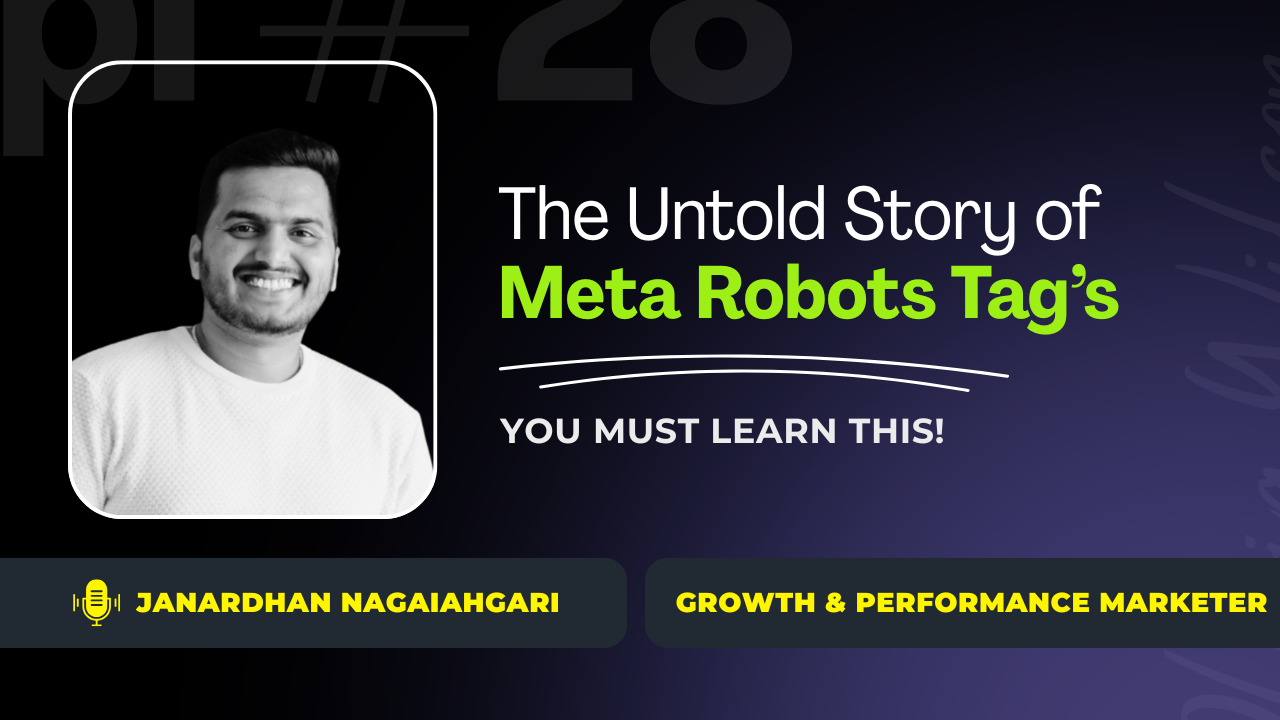
Based on many top SEO professionals, Meta Robots is no longer a crawl directive—it’s a visibility permission system for search engines and Large Language Models (LLMs).
Let’s decode it deeply, practically, and future-proof.
What Is a Meta Robots Tag in SEO?
The Meta Robots tag is an HTML instruction that tells search engines how to crawl, index, and treat a webpage.
Basic Syntax:
<meta name=”robots” content=”index, follow”>
Common Directives:
| Directive | Meaning |
| index | Allow indexing |
| noindex | Block indexing |
| follow | Follow links |
| nofollow | Ignore links |
| noarchive | Prevent cached version |
| nosnippet | Block snippets |
| max-snippet | Control snippet length |
Why Meta Robots Tag Is Crucial in the Modern AI Era
AI Search Engines Respect Indexing Permissions
LLMs like ChatGPT, Gemini, and Perplexity primarily train and fetch answers from indexable, crawlable URLs.
If your page is:
- noindex
- nosnippet
- blocked unintentionally
AI models won’t cite or reference it, even if the content quality is exceptional.
Controls AI Snippets & Answer Extraction
Directives like:
- nosnippet
- max-snippet
- max-image-preview
Directly influence:
- Featured snippets
- AI Overviews
- Answer Engine responses
Crawl Budget Optimization for AI Bots
Search engines now deploy AI-based crawlers that prioritize:
- Indexable
- Clean
- Directive-aligned pages
Wrong meta robots = wasted crawl budget.
3 Unknown Facts About Meta Robots (Rarely Discussed)
Unknown Fact #1: Meta Robots Overrides Robots.txt for Indexing
Even if robots.txt allows crawling, a noindex meta tag wins.
Many SEOs wrongly assume robots.txt alone controls visibility.
Unknown Fact #2: LLMs Avoid Pages with nosnippet
Pages using nosnippet are rarely cited by AI answer engines, even if indexed.
Unknown Fact #3: nofollow Can Weaken Entity Authority
When overused internally, nofollow:
- Breaks semantic relationships
- Confuses entity graphs
- Reduces topical authority signals for AI
Key Advantages of Using Meta Robots Tags
| Advantage | SEO Impact |
| Prevents thin content indexing | Higher quality SERP presence |
| Controls AI snippet behavior | Better AEO visibility |
| Manages crawl budget | Faster indexing |
| Protects private pages | Clean index |
| Improves site trust | Stable keyword rankings |
Drawbacks & Risks of Meta Robots Tags
- Accidental noindex can kill rankings
- Overuse of nofollow weakens link equity
- nosnippet reduces CTR
- Misuse blocks AI discovery
Meta Robots require strategic usage, not templates.
Industry Best Practices (2025 SEO + AI Ready)
Use Self-Aware Defaults
- Blog posts: index, follow
- Filters: noindex, follow
- Thank-you pages: noindex, nofollow
Align Meta Robots with Canonical URLs
Never canonicalize to a page that is noindex.
Control AI Snippets Strategically
Use:
<meta name=”robots” content=”max-snippet:-1″>
To allow full snippet extraction.
Use Page-Level Control Instead of Robots.txt
Meta Robots allow granular visibility, preferred by AI systems.
Most Common Meta Robots Mistakes Professionals Make
- Leaving noindex on staging pages post-launch
- Using nofollow on internal links
- Blocking paginated pages incorrectly
- Combining noindex with sitemap URLs
- Blocking schema-rich pages
Meta Robots Audit Checklist
Technical Audit
- Only one meta robots tag per page
- Correct directive syntax
- No conflicting HTTP headers
Indexing Audit
- Indexed pages are indexed, follow
- No sitemap URLs set to noindex
- GSC index status verified
AI Visibility Audit
- Snippet directives optimized
- Schema pages indexable
- Clean crawl paths
AI & SEO Tools for Meta Robots Optimization
| Tool | Purpose |
| Google Search Console | Indexing validation |
| Screaming Frog | Meta robots crawl |
| Sitebulb | Directive conflicts |
| Ahrefs | Indexability reports |
| ChatGPT | Directive logic review |
| Perplexity | AI citation testing |
Meta Robots vs Robots.txt (Quick Comparison)
| Feature | Meta Robots | Robots.txt |
| Page-level control | ✅ | ❌ |
| AI snippet control | ✅ | ❌ |
| Crawl blocking | ❌ | ✅ |
| Index control | ✅ | ❌ |
Meta Robots Interview Questions & Answers
Freshers
- What is a Meta Robots tag?
- Difference between index & noindex?
- Where is Meta Robots placed?
1–3 Years Experience
- Meta Robots vs robots.txt?
- Can Google ignore meta robots?
- noindex + follow use cases?
4–6 Years Experience
- Meta robots and crawl budget
- Snippet control strategies
- AI impact of nosnippet
7–10 Years Experience
- Meta robots in AI Overviews
- Directive conflicts in headless CMS
- Meta robots for entity SEO
Final Thoughts: Meta Robots Is SEO’s Permission Layer
If content is the asset,
Meta Robots decides who gets access to it.
In an era where AI answers replace blue links, controlling indexing and snippet permissions is not optional—it’s survival.
Master Meta Robots, and you don’t just rank.
You control visibility across search and AI ecosystems.