Why Internal Linking Is Quietly Deciding Your Rankings in 2026
Imagine publishing world-class content, building backlinks, optimizing Core Web Vitals—and still not ranking.
Now imagine fixing only internal links and watching pages jump from page 2 to the top 3.
Internal linking is no longer a “basic SEO task.”
In the AI-first search era, it has become the invisible architecture that helps Google, Answer Engines, and LLMs understand, trust, and prioritize your content.
Most websites do it randomly.
Top-ranking websites do it strategically, mathematically, and intentionally.
This guide will show you how No.1-ranking sites use internal linking today—and how you can replicate it.
What Is Internal Linking in SEO? (Beyond the Basic Definition)
Internal linking refers to hyperlinks that connect one page of a website to another page on the same domain.
But in modern whitehat SEO, internal links are signals, not navigation elements.
They help search engines:
- Discover new pages faster
- Understand topical relationships
- Assign contextual importance
- Distribute ranking equity strategically
In AI search systems, internal links act like contextual memory paths, guiding LLMs toward authoritative answers within your site.
let us try to understand this with an example below
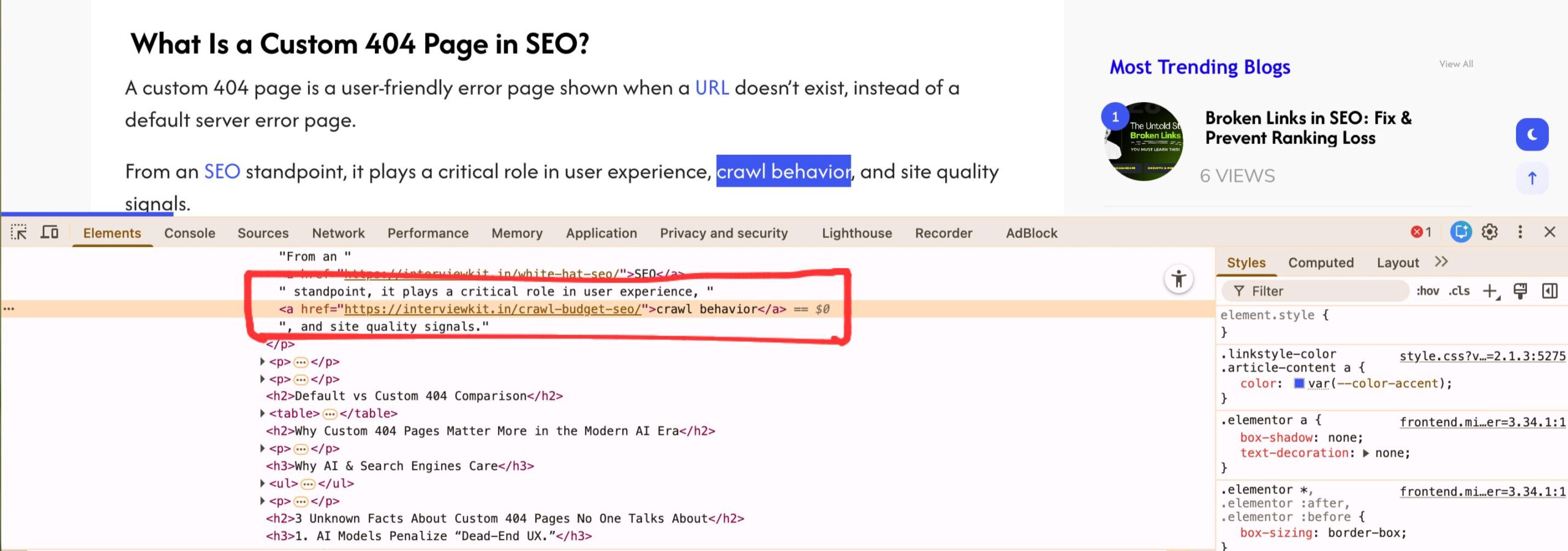
in above image if you can pay attention to the highlighted text, it will give you an overview of internal link.
Why Internal Linking Matters More in the Modern AI Search Era
Search has shifted from keyword matching to context understanding and entity relationships. Internal linking is how you teach machines your site’s logic.
Key Reasons It’s Critical Today
- Google uses internal links to infer topic clusters
- AI Overviews rely on internal context consistency
- LLMs extract answers from well-connected content
- Weak internal linking = orphaned expertise
Unlike backlinks (which you don’t fully control), internal links are 100% controllable ranking levers.
Types of Internal Links in SEO (Complete Classification Guide)
Why Knowing the Types of Internal Links Changes Rankings
Most websites “add internal links” without knowing which type actually moves rankings.
But top-ranking sites don’t link randomly.
They use specific internal link types for specific SEO outcomes—crawlability, topical authority, conversions, and AI answer visibility.
If you don’t understand these link types, you’re leaving ranking equity unused.
1. Navigational Internal Links
These are links placed in menus, headers, footers, and breadcrumbs to help users navigate the website.
Navigational links define your site’s core hierarchy. Google uses them to identify important categories and service pages.
Examples
- Main menu category links
- Footer service links
- Breadcrumb navigation
2. Contextual Internal Links (Most Powerful Type)
What They Are
Links are embedded naturally within body content, surrounded by relevant text.
Contextual links carry maximum semantic value. They tell search engines exactly why two pages are related.
Examples
- Blog linking to a pillar page
- Guide linking to a case study
- Article linking to a related tutorial
3. Footer Internal Links
What They Are
Links are placed in the website footer, usually site-wide.
Why They Matter
They reinforce accessibility and provide crawl paths—but are treated with lower weight than contextual links.
Examples
- Privacy policy
- Service pages
- Location pages
4. Header Internal Links
What They Are
Links are placed in the top navigation bar or mega menus.
Why They Matter
They signal top-priority pages to search engines and users.
Examples
- Services
- Products
- Categories
5. Breadcrumb Internal Links
What They Are
Hierarchical links show the page’s position in the site structure.
Why They Matter
Breadcrumbs improve crawl depth understanding, and UX clarity.
Example
Home → Blog → SEO → Internal Linking Guide
6. Image-Based Internal Links
What They Are
Clickable images that link to internal pages.
Why They Matter
They pass authority through image alt text, acting as anchor text.
Examples
- Blog thumbnails linking to posts
- Banner images linking to services
7. Related Content Internal Links
What They Are
Links added under “Related Posts” or “You May Also Like” sections.
Why They Matter
They help reduce bounce rate and improve session depth, which indirectly supports SEO.
Examples
- Related blog widgets
- Plugin-generated recommendations
8. Pagination Internal Links
What They Are
Links that connect paginated content across multiple pages.
Why They Matter
They help search engines crawl large content sets like blogs, products, or categories.
Examples
- Page 1 → Page 2 → Page 3
- Category pagination
9. Call-to-Action (CTA) Internal Links
What They Are
Links designed to push users toward conversion pages.
Why They Matter
They guide users from informational intent to transactional intent.
Examples
- “Check our SEO services”
- “Download the guide”
10. Silo or Topic-Cluster Internal Links
What They Are
Structured links connecting pillar pages with supporting cluster content.
Why They Matter
They build topical authority, the strongest ranking factor in modern SEO.
Examples
- Pillar → Blogs
- Blogs → Pillar
- Cross-links within cluster
SEO Notes
- Essential for competitive niches
- Highly AI-friendly structure
- Drives long-term ranking stability
Internal Link Types Comparison Table
| Type | SEO Power | Best Use Case |
| Contextual | ⭐⭐⭐⭐⭐ | Ranking & AI answers |
| Silo/Cluster | ⭐⭐⭐⭐⭐ | Topical authority |
| Header | ⭐⭐⭐⭐ | Priority pages |
| Breadcrumb | ⭐⭐⭐⭐ | Structure clarity |
| CTA | ⭐⭐⭐ | Conversions |
| Related Posts | ⭐⭐⭐ | Engagement |
| Image Links | ⭐⭐⭐ | Visual navigation |
| Footer | ⭐⭐ | Utility access |
| Pagination | ⭐⭐ | Large sites |
Internal Links vs External Links: Which Matters More for SEO in the AI Era?
Most SEO professionals still argue about internal vs external links as if one must win.
But here’s the truth top-ranking sites understand:
Internal links decide how authority is used. External links decide how authority is earned.
In the AI-first search era—where Google, ChatGPT, Perplexity, and Gemini rely on context, trust, and relationships—both links play very different but equally critical roles.
What Are External Links?
External links (backlinks) are links from other websites pointing to your site, or outbound links from your site to others.
They signal:
- Trustworthiness
- Authority
- Popularity
- Real-world relevance
In AI-driven search, external links act as third-party validation of your expertise.
Internal Links vs External Links: Core Differences Explained
| Factor | Internal Links | External Links |
| Control | 100% controllable | Limited control |
| Purpose | Structure & authority flow | Trust & credibility |
| Crawl impact | High | Medium |
| Ranking influence | Indirect but strong | Direct & strong |
| AI context building | Very high | High |
| Cost | Free | Often expensive |
| Risk | Low | High (spam risk) |
How Internal Links Impact SEO (In Depth)
1. Authority Distribution
Internal links decide where the ranking power flows.
High-authority pages can boost newer or commercial pages instantly.
2. Crawl Budget Optimization
Well-linked pages get crawled more often, improving freshness signals and faster indexing.
3. Topical Authority
Internal links create semantic relationships, helping Google and LLMs understand your content depth.
4. User Experience Signals
They improve session depth, reduce bounce rate, and enhance engagement metrics.
How External Links Impact SEO (In Depth)
1. Domain Trust & Authority
External links act as votes of confidence from the web.
2. Competitive Differentiation
In competitive niches, backlinks are often the deciding factor between top 3 positions.
3. Entity Recognition
Links from authoritative domains help Google associate your site with trusted entities.
4. AI Training & Citations
LLMs favor sources referenced across trusted domains.
3 Things Most SEOs Get Wrong About Internal vs External Links
1. “Backlinks Matter More Than Internal Links”
False. Backlinks bring power; internal links decide how well that power is used.
2. “Internal Links Don’t Directly Affect Rankings”
They do—by improving crawlability, relevance, and authority flow.
3. “Outbound Links Leak SEO Juice”
Outbound links to authoritative sources increase trust, not reduce rankings.
3 Unknown Internal Linking Facts No One Talks About
1. Google Measures Internal Link Consistency, Not Just Count
It’s not about how many links point to a page—but whether similar pages link to it consistently. Random linking patterns dilute authority signals.
Example:
If all SEO blogs link to “Technical SEO Guide” using varied anchors, Google sees it as a central entity.
2. Anchor Text Distribution Internally Is More Powerful Than External
Internal anchor text is treated as high-confidence intent data because you control it.
Over-optimized external anchors can trigger spam signals.
Internal anchors? Much safer—and more influential.
3. Internal Links Influence Crawl Budget Allocation
Pages with strong internal links get crawled more frequently.
Impact:
- Faster indexation
- Faster content refresh recognition
- Better AI snapshot inclusion
This is crucial for large content sites and SaaS blogs.
How Internal Linking Works
Think of your website as a knowledge graph, not a folder structure.
- Pillar pages = hubs
- Cluster pages = spokes
- Contextual links = semantic bridges
The stronger the internal connections, the clearer your site’s topical authority becomes.
Key Advantages of Internal Linking in SEO
1. Faster Indexation & Better Crawlability
Internal links act as discovery signals. Pages linked from authoritative hubs get crawled faster and more frequently.
2. Stronger Topical Authority
Well-linked content clusters tell Google and LLMs:
“This site deeply understands this topic.”
3. Improved User Engagement Metrics
Relevant internal links reduce bounce rate, increase session duration, and improve behavioral signals.
4. Controlled PageRank Distribution
You decide which pages deserve ranking power—no dependency on backlinks.
Drawbacks & Limitations of Internal Linking
Internal linking is powerful, but not magic.
Key Limitations
- Cannot replace high-quality content
- Poor structure can confuse crawlers
- Over-optimization can dilute relevance
- Requires ongoing audits as content grows
Used incorrectly, it becomes noise instead of a signal.
Internal Linking Best Practices Used by Top-Ranking Websites
1. Follow a Topic-First Linking Strategy
Links should reinforce topical relevance, not just navigation.
Best Practice
- Blog → Pillar
- Pillar → Commercial
- Commercial → Supporting content
2. Use Natural, Descriptive Anchor Text
Avoid:
- “Click here”
- Exact-match stuffing
Prefer:
- Partial match
- Contextual phrases
- Semantic variations
3. Limit Links Per Page (Quality Over Quantity)
Ideal range:
- Blogs: 5–15 contextual links
- Pillar pages: 20–40 structured links
Too many links dilute attention and authority.
Internal Linking Audit Checklist (SEO-Approved)
Crawl & Structure
- Identify orphan pages
- Check crawl depth (≤3 clicks)
- Validate sitemap vs internal links
Anchor Text Review
- Remove over-optimized anchors
- Ensure semantic variation
- Match intent, not keywords
Authority Flow
- Link from high-traffic pages to priority pages
- Reinforce money pages via pillars
- Reduce links from low-value pages
UX & AI Readability
- Contextual placement
- No forced links
- Logical content flow
Internal Linking Examples
| Page Type | Links From | Links To | Purpose |
| Blog | Other blogs | Pillar page | Authority building |
| Pillar | Blogs | Service page | Conversion support |
| Service | Pillar | Case study | Trust reinforcement |
| Case Study | Blog | Service | Bottom-funnel push |
AI Tools to Leverage Internal Linking in 2026
Top Tools
- Screaming Frog – Orphan pages & depth
- Sitebulb – Internal link visualization
- Link Whisper – AI-based link suggestions
- Surfer SEO – Contextual relevance signals
- ChatGPT – Anchor text optimization & linking logic
AI tools help with scale, but strategy still requires human intent mapping.
Most Common Internal Linking Mistakes Professionals Make
1. Linking Only for Navigation, Not SEO
Menus ≠ contextual links.
2. Over-Linking to Homepage
This wastes internal authority.
3. Ignoring Old Content
Older high-authority blogs are gold mines for internal linking.
4. Using Exact-Match Anchors Everywhere
This creates unnatural patterns detectable by AI systems.
Internal Linking Interview Questions (By Experience Level)
These are some of the most commonly asked SEO interview questions and answers related to Internal Linking.
Freshers (0–1 Year)
- What is internal linking?
- Difference between internal & external links
- Why internal links matter for SEO
1–3 Years Experience
- How does internal linking impact crawlability?
- What are orphan pages?
- How do you choose anchor text?
4–6 Years Experience
- How do you design a topic cluster?
- Internal linking vs backlinks: which is stronger?
- How do internal links affect PageRank flow?
7–10 Years Experience
- How do internal links influence AI Overviews?
- How do you audit internal linking for large sites?
- How do you balance UX and SEO in internal linking?
10 FAQ Snippets (AEO & LLM-Optimized)
1. What is internal linking in SEO?
Internal linking connects pages within the same website to help search engines understand structure, relevance, and authority distribution.
2. How many internal links should a page have?
There’s no fixed number, but 5–15 contextual links for blogs and 20–40 for pillar pages is a safe range.
3. Does internal linking help rankings?
Yes. Internal links distribute PageRank, improve crawlability, and strengthen topical authority—direct ranking factors.
4. Are internal links more powerful than backlinks?
They don’t replace backlinks, but they offer full control and strong contextual signals, especially for AI search systems.
5. What is an orphan page?
A page with no internal links pointing to it makes it hard for search engines to discover or rank.
6. How do internal links affect AI Overviews?
AI systems rely on internal context consistency. Strong linking helps LLMs identify authoritative answers.
7. Can internal linking hurt SEO?
Yes, if over-optimized, irrelevant, or excessive. Poor linking confuses crawlers and users.
8. What anchor text should I use?
Use natural, descriptive, and intent-based anchor text—not repetitive exact-match keywords.
9. How often should internal linking be audited?
Every 3–6 months, or whenever new content is added at scale.
10. Which tools are best for internal linking?
Screaming Frog, Sitebulb, Link Whisper, and AI tools like ChatGPT for anchor optimization.
Final Thought
In 2026, internal linking is not optional SEO hygiene—it’s a strategic growth lever.
Websites that win in Google, AI Overviews, ChatGPT, Perplexity, and Gemini are not publishing more content—they are connecting it better.